My thoughts were scattered across four places, so I built Throughline
I caught the vibecode bug. Equipped with an idea and Claude Code, I built my ideal journal that uses AI to help synthesize my thoughts.

TL;DR: I built Throughline, a voice-and-text journal that uses AI to read across your entries to surface patterns that you might miss while living through them. After a few chaotic weeks of building and testing it with friends, I'm excited to finally share it publicly!
Try it at throughlinejournal.com.
In this post, I cover why I built it and what it does. If you're wondering how I built it (as someone with zero technical chops or an engineering background), let me know and I'll share my ongoing journey in all its honest chaos.
The "Why"
Life in Silicon Valley is uniquely loud: everyone is optimizing, shipping, fundraising, networking, building. Everyone is busy, ambitious, and probably thinking about five things at once.
The higher-stakes my life gets, the harder I often find it to hear myself think.
So I journal.
But as much to my therapist or my own chagrin, I don't do so in a disciplined, consistent way... just whenever things get too tangled in my head, and I find myself seeking an outlet. Whatever the medium is, whether onto a page or in a conversation with a therapist or loved one, the processing that happens when I share my thoughts brings me relief.
Recently, AI chats have also become one of those places.
I started pasting bits of my life into AI chats and asking it what it noticed.
Except I now had bits of my inner thoughts scattered across four disconnected systems: paper journals, conversations with loved ones, therapy, and AI chats.
None of them held the throughline.
I wanted something that held enough context in one place to notice patterns I missed.
And so, living in the Bay Area and surrounded by cracked engineers, I too developed an irrevocable itch to "vibecode". Coupled with Claude Code (even with zero experience in software engineering), I was delusional and eager enough to build my ideal AI journal.
Where Throughline came from
Throughout college, my early career, and later my MBA, I loved bullet-journaling (including stationary adventures, finding the perfect bujo layout). I carried it around everywhere I went.
But at the end of every journal, I'd spend time migrating the key insights into the next journal by hand.
In hindsight, this manual integration process was basically the original version of Throughline.
A fun detour, but the original concept of bullet journaling was invented by Ryder Caroll and is brilliantly summarized in this video of his: Bullet Journal. Ryder grew up with ADHD, and to manage this, he invented a simple and efficient system to combine both productivity and mindfulness. In a world where being busy was often a status symbol, Ryder's bullet journal methodology was a personal organization system flexible to each user.
What I built
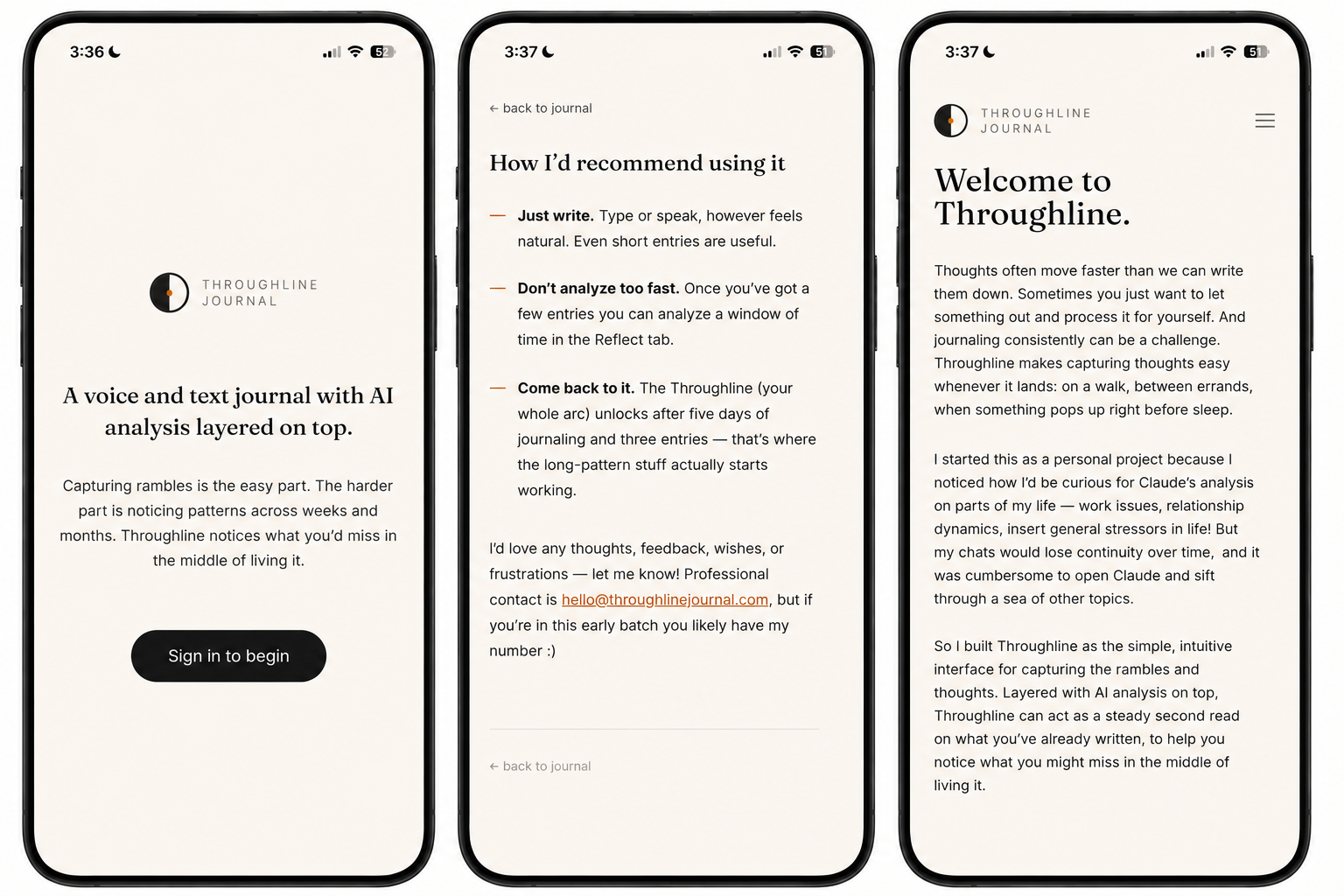
Throughline is a voice-and-text journal designed to feel calm and simple, while quietly helping you notice patterns across time. I had two main priorities while designing the app:
- Keep what's good about journaling on paper: calm, private, simple
- Add the one thing a paper journal can't do: read across months of entries
Most journaling apps are filled with productivity dashboards... I wanted something less intrusive and quieter: the upside of technology without the tradeoff.
Here's what I ended up with: Throughline's version 1 interface!
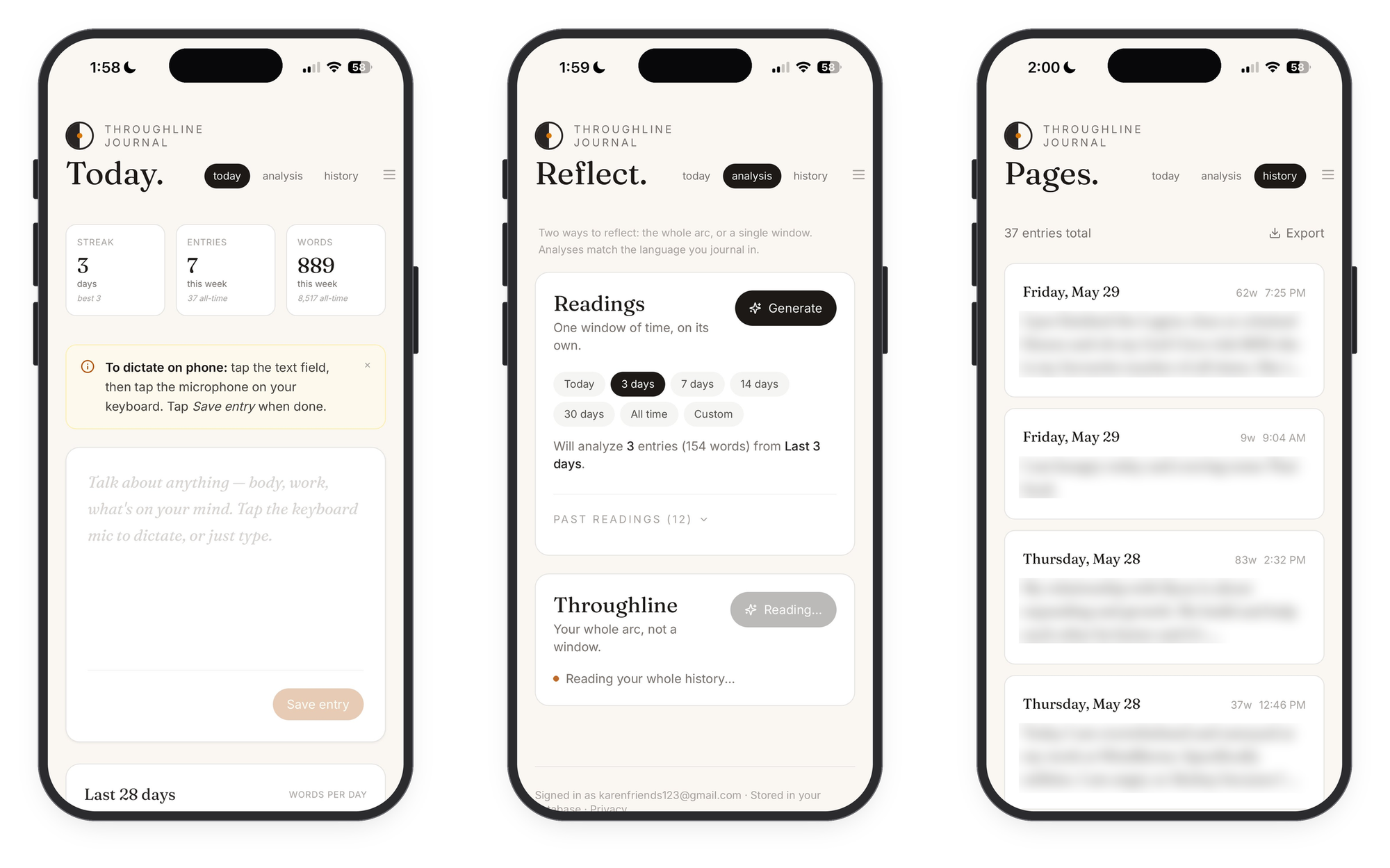
The journal part (Today):
Log a text entry, or dictate it with your phone's keyboard mic. Most of my entries get recorded between errands or on a walk.
The observations (Reflect):
Once you have a few entries, you can generate:
- a Reading --> an analysis of one window of time
- a Throughline --> a broader analysis across your journal history
The result is a mini-report that tells you what it sees: new patterns, resolved ones, and what's gone quiet without resolution.
The logged journal entries (Pages):
View all your journal entries in the 'history' tab, where you can see everything in one place and easily export it.
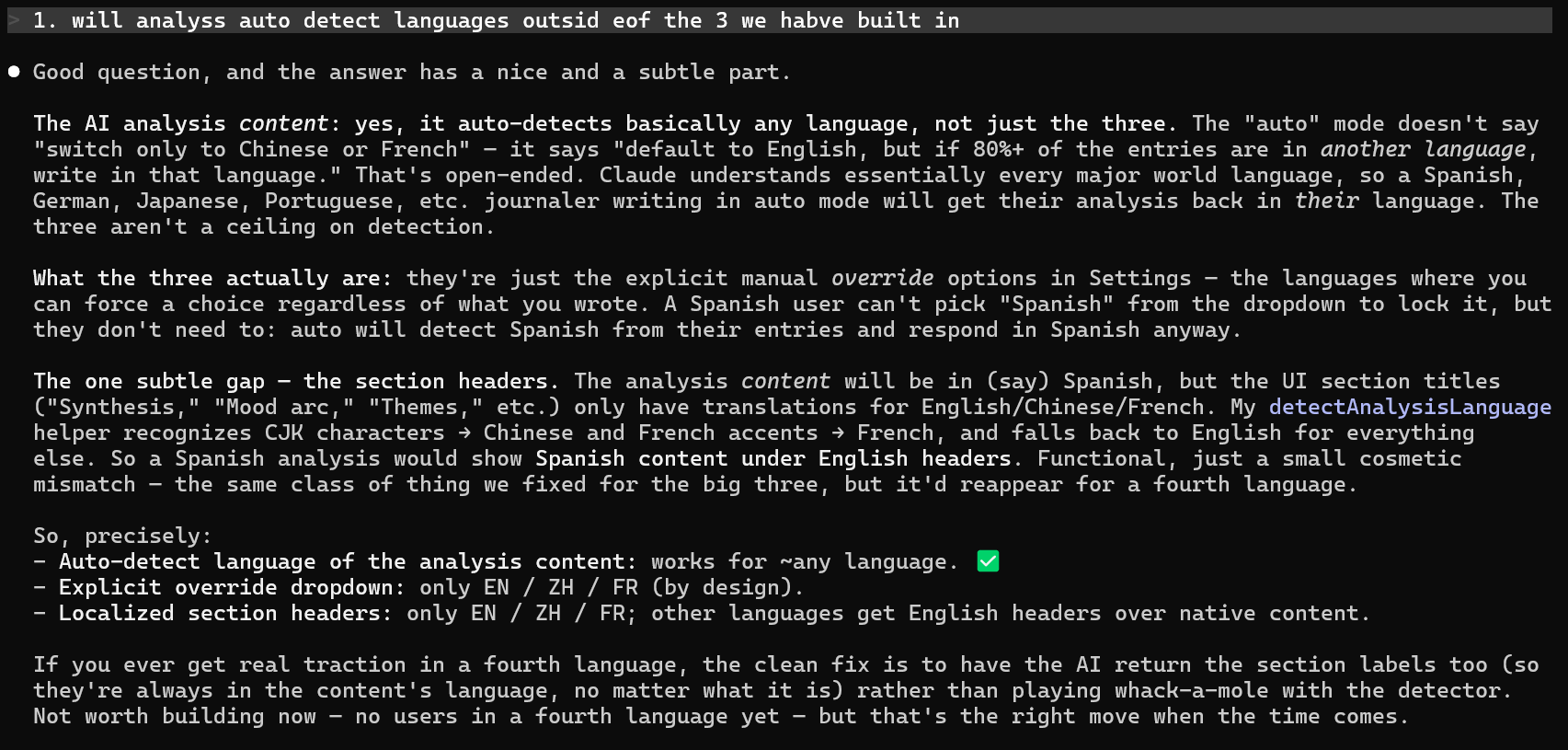
Separately, I also wanted the app to work in multiple languages, so my parents and friends abroad could use it. Today, Throughline has built-in settings where you can select English, Chinese, and French as the default, or the AI analysis can also auto-detect any language you write in.
If my human explanation above on the language note is unclear, here's a behind-the-scene look on basically the interface of how I engaged with Claude Code to set-up each piece of Throughline.
Protecting the feeling behind journaling
I really wanted to protect the way journaling on paper feels. When I open a new page in my journal, it doesn't ask anything of me: no badge, no reward, no dopamine rush for showing up.
Most journaling apps gamify their way into our habits.
I wanted Throughline to try and stay out of mine.
So Throughline's design is intentionally restrained: a simple interface with minimal clutter and dopamine loops. And while there is a streak counter, the intent is to be informational, with the option to opt in or out of nudges. Some friends wanted specific nudges and reports, so those exist, but all are off by default.
A few honest caveats
I struggled to decide what features to prioritize in this first version and so following is an account of where things stand today – some deliberate choices, vs. some features that are just not there "yet". This list is an evolving, constant shuffle of prioritization.
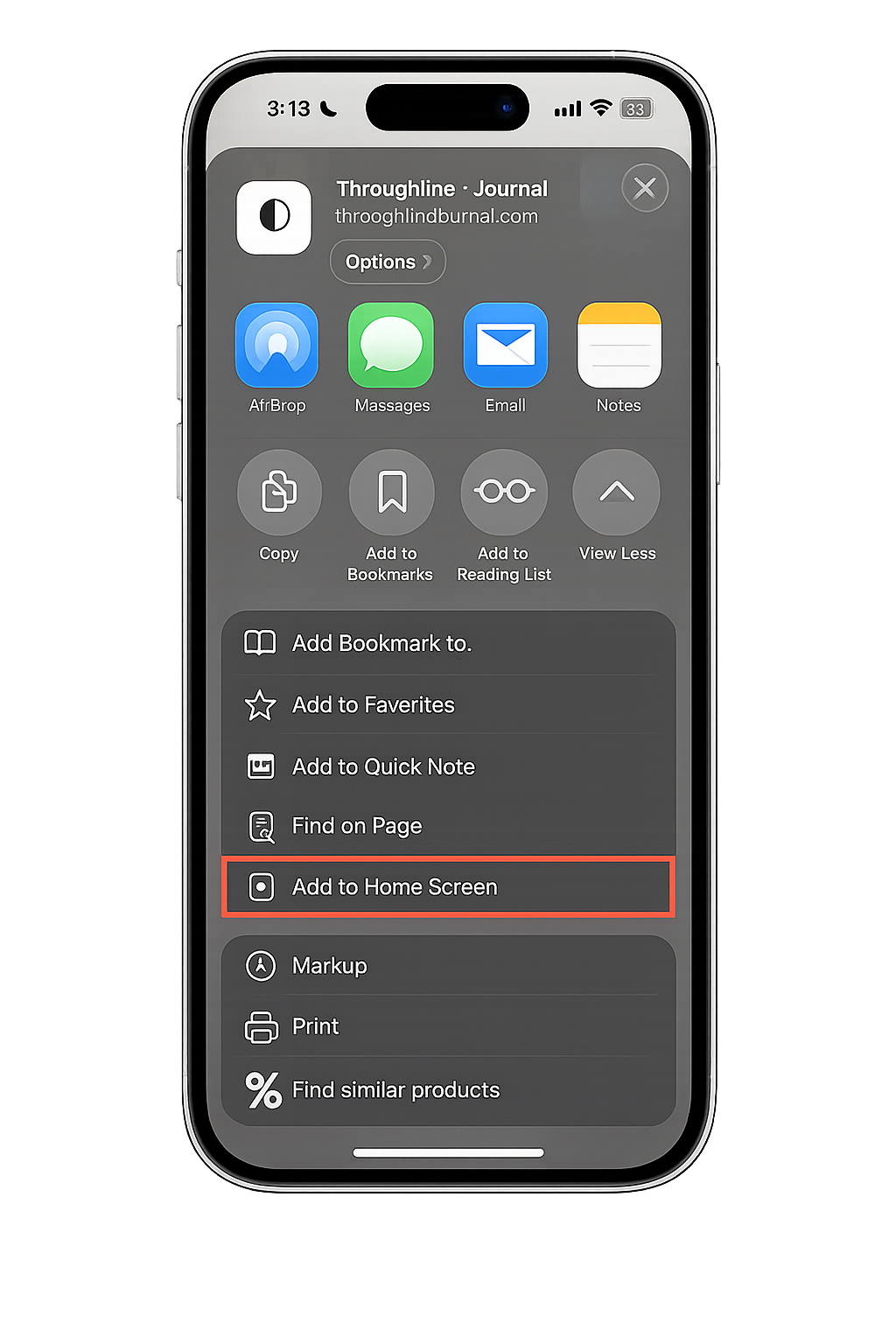
- It's a web app, not a native one: You can add it to your home screen so it mimics a real app, but right now I've held off on building an "official" App Store native app given this existing alternative.
Easy trick to save any website as an "app" on your homescreen
For iPhone users, on the Safari app, tap the "share" button (little square with arrow pointing up), scroll down and find the "Add to Home Screen" selection.
Official instructions on the Apple website
- Voice uses your phone keyboard's mic, not a built-in one. Right now, there's no recording feature, and it relies on the device's native microphone to dictate. Personally, I find the iPhone voice-to-text translation mediocre – shameless plug for Wispr Flow, which has cleverly exploited this pain point and actually dictates like it was written (without requiring go back edits).
- It's cost-capped as it's currently tied to my API key. Every time you run an analysis, it charges typically a cent or so, depending on the volume. While this is minimal and manageable for a small audience, this can easily rack up and be abused (spot this story here of how people were abusing the Amazon chatbot and accessing Claude insights for free). For most users, you'll never notice this cap, but as the volume of users and journal entries (hopefully) goes up, I'll likely switch to a paid tier for heavy users.
- It's been tested on ~20 friends (unlucky guinea pigs). Real bugs still surface. If you've found one, please let me know at hello@karenye.net.
- The AI can read your entries. For the feature to have an AI analyze your entries, it has to be able to read them, which requires the entries to be stored somewhere. So as the operator of Throughline, I technically have access to anything in the database, the same as any cloud journal that isn't end-to-end encrypted (Day One, Notion, iCloud Notes). My commitment is to always respect your privacy and the privacy page lays out all the details.
What's next?
Here's a list of ideas and action items I've collected from friends and my own desires:
- A long-form Year-in-Review (Spotify Wrapped, but for your own thoughts).
- More languages
- Better at-a-glance dashboards
- Option to share your "Analysis Readings"
- Turning this into an "actual app" (available on an app store vs. just a website)
- If you have suggestions, I’d love to hear them (hello@karenye.net)
Shameless plug to try it and let me know what you think!
If any of this resonates – the scattered inner life and the idea of AI helping you reflect instead of replace connection – I'd love for you to try Throughline.
It’s free, and currently running entirely on a personal-project budget.
Try Throughline here.